
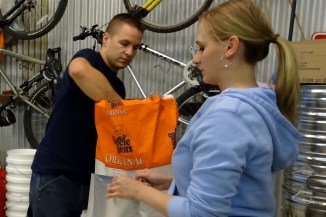
 Do-it-yourself long-term food and gear storage is not only possible, but it’s also easy when you use Mylar bags and oxygen or moisture absorbers. It’s inexpensive, too, and yet it can deliver 25-30 years of safe storage.
In fact, D-I-Y Mylar bag storage is the least expensive method for accomplishing long-term food storage. It can be downright cheap if you purchase bulk foods. No special tools are required, either. All you need is an ordinary household clothing iron, a carpenter’s level, and, of course, Mylar Bags.
While it’s true that storing food in sealed #10 metal cans provides the best long-term protection, equipment and materials are expensive, whereas Mylar bags can deliver a similar 20-30 year shelf-life. A heat-sealed Mylar bag is not as durable as a metal can, but proper storage can alleviate this shortcoming.
To extend the shelf-life of food staples, five things are required: 1) Clean, uncontaminated food and a sanitary environment for packaging. 2) Removal of oxygen and preventing oxygen from seeping into the container. 3) Elimination of light during storage. 4) Removal and keeping moisture away from the stored food. 5) Maintaining a fairly constant storage temperature, ideally cool — but not freezing-unfreezing-refreezing.
Metal cans and Mylar bags can both be used to meet these needs. But as with all food preservation processes, well-selected ingredients, quality packaging, and proper handling are integral to success. This article will help you accomplish this by using the step-by-step food storage techniques described and illustrated in this article.
What to Pack First
Dry goods are the place to start. Products such as rice, beans, chickpeas, and pasta are easy to pack in Mylar and very inexpensive when purchased in bulk. With food such as this, you can create an inexpensive alternative to expensive emergency-food buckets.
Not only are these food staples stomach-filling, but they are also a source of the carbohydrates and proteins that are essential components of an emergency food supply. If you can add a can of meat or a handfull of freeze-dried vegetables and a few spices, you can create a nutritious and savory family meal.
Of course, you will want to add a variety of other foods to these staples to achieve nutritional balance, but these food staples like rice and beans are the place to start. Most of the world subsists on these staples, so you can too if it becomes necessary. Nonetheless, regard these staples as the foundation and stomach-filling bulk for meals, not the only foods in your emergency supply.
Buy Bulk Food in Large Quantities
Your grocery store probably doesn’t sell restaurant-size bags of food so you may need to find a different source. The effort is worth it. The cost of these foods is surprisingly low when purchased in bulk quantity. When you purchase 50-pound bags of rice, beans, and pasta at a big-box store or restaurant supply, or even Walmart online, the cost of this project will remain surprisingly low.
The repackaging task is simple and straightforward. You just need a clean area and space to work.
The long-term storage aspect can easily be accomplished if you use basic food sanitation methods, reasonable care, and follow the 7-step process outlined in this article. This process makes it possible to attain a 20-30 year or longer shelf life of appropriate foods when you follow the step-by-step process illustrated here.
Plastic Bags vs. Mylar (metalized plastic) Bags
Unfortunately, plastic bags, including the thick plastic materials used with expensive vacuum sealing machines, are not adequate for long-term food storage. Surprisingly, even the thick plastic of a 5-gallon food-grade plastic bucket is not enough for multiple-year storage. Plastic alone simply doesn’t work for long-term food storage. Over time, even the best plastics cannot stop the infiltration of oxygen and moisture.
Mylar bags are the answer. They are essentially flexible metal cans that you can heat-seal at home. Though Mylar is not as durable as a metal can, and even 7-mil heavy-duty Mylar bags are susceptible to damage if roughly handled or improperly stored, they are still far superior to even the thickest plastic when the goal is long-term storage.
Heavy-duty Mylar bags (5-7 mil) are the best choice for D-I-Y long-term storage and absolutely necessary for bags larger than 1 gallon. Thinner 3.5 mil Mylar bags are easier to seal and adequate for some purposes, but we recommend using heavy-duty bags. It does take a bit of practice to seal the heavy-duty bags if you are using an ordinary household iron, but most people find it an easy project, even for the first-timer.
Consider organizing a “packing party” with family or friends. This is a great way to implement an assembly-line process that makes the task fast, efficient–and fun.
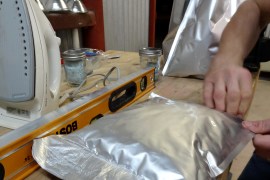 What You Will Need for Do-It-Yourself Mylar Packaging and Storage

(Sources for these products are listed at the end of this article)
1. Mylar bags. Bag size and thickness (mils) is dictated by the contents and how it will be stored. However, thicker bags (7mil) are necessary for packaging anything with sharp edges such as pasta, and they are a good idea for all foods. Storage in containers, stacking on shelves, and simple tasks of relocation can result in small punctures which will introduce contamination into the bag. The thicker the bag, the better the protection.
What size bags should you use? In our experience, 1-gallon bags are the best choice for all around use. The next commonly used size is 1-quart, but the cost of these bags is nearly the same as the 1-gallon size, so if cost is an issue stick to the 1-gallon size. If you need a 1/2 gallon bag for some reason, the 1-gallon bag can be cut in half. But, smaller size bags are useful for items such as spices, gravy, and sauce mixes.
Larger size Mylar bags, such as 5-gallon liners for plastic buckets, are not usually a good choice. Rarely can that quantity be consumed before the food in the opened container begins to spoil.
Notwithstanding, 5-gallon Mylar bags inserted into a 5-gallon plastic buckets are popular with those who want their food supply to be highly mobile. These individuals often pack their food in quart or gallon-size Mylar bags, and then put these sealed bags into a Mylar lined bucket for added protection. Both the 5-gallon Mylar bucket liner and all the food bags, are heat sealed and contain oxygen absorbers.
Those who are packing food for use by one or two people, sometimes select 1-quart bags as their standard size. These are also useful for assembling pre-made meals. Conversely, for larger families and even groups, the 1-gallon bag is often the best choice.
2. ‘Oxygen Absorber’ Packets (Food). 1-Gallon Bag: Use a single 500cc of oxygen absorber, plus two 100-cc absorbers. 2-Quart Bag: Use three 100cc absorbers. 5-Gallon Bag: Use seven 500cc absorbers.
2b. ‘Desiccant’ Packets (Gear). For waterproof packaging, or long-term storage of non-food items such as electronics, books, firearms, and tools, use desiccant (moisture absorbers) rather than oxygen absorbers.
The amount of desiccant needed will vary by brand of desiccant. So, read the product label, and match the quantity of desiccant needed for protecting the cubic-inch volume of the bag. When in doubt, use more.
The item(s) to be stored must be thoroughly dry before bagging. Guns and other metal objects, such as hand tools, should be lightly coated with a rust inhibitor such as Boeshield T-9 before putting them in the bag. However, keep liquids such as lubricating oil and liquid rust-inhibitors from coming into contact with the desiccant as it will diminish its effectiveness.
Do not store oiled guns or tools in the same bag as electronics. When storing batteries, keep them from coming coming into contact with the bag itself. Wrap batteries in layers of paper or plastic, or cardboard before inserting them into the Mylar bag. Since the bag is impregnated with metal, it can cause batteries to discharge. This precaution will also help protect your electronics if the batteries leak.
Advice: Do not use oxygen absorbers and desiccant in the same container as they can counteract each other. If you want to use both, double-bag the item and put the oxygen absorber in one and the desiccant in the other.
3. Clothing Iron, Hair Straightening Flat iron, or ‘Mylar Bag Sealer.’ An ordinary household iron or hair straightener can be used without damaging the iron, as long as the user is careful to not overheat the Mylar bag. However, Mylar Bag Sealers are designed for this purpose are easier to use, faster, and they provide a better seal than does a household iron. Notwithstanding, a Mylar bag can be adequately sealed using an ordinary clothing iron or hair iron, but it may require more practice before a uniform seal can be consistently accomplished.
4. Carpenter’s Level (Only needed if using a clothing iron. This tool isn’t needed if you are using a ‘Mylar Bag Sealer.’)
5. Steel Storage Container. For most people, a new galvanized trash can or a used food-grade 30 or 55-gallon steel drum is the best choice for storing food. Other containers may work fine as long as they are made from steel, are food safe and have not been previously used for storing unhealthy substances, and are galvanized or painted with a food-safe rust inhibiting treatment. Of course, Mylar bags can be stored on a pantry shelf or in a plastic bin, too, but only steel containers will provide protection from rodents.
For Optimal Health
For optimal health during an emergency situation, augment these dry goods with canned foods, freeze-dried vegetables, and dehydrated or freeze-dry meat-flavored soy protein. Foods with fats, such as meat and butter, have a much shorter shelf life. (Usually, 2-years in cans, 5-years in freeze-dry form). Vegetables containing acids, such as tomato products, have a shorter shelf-life than vegetables such as corn or green beans. For long-term food storage, soy protein, pinto beans, black beans, etc. are a better source of protein than meat due to this spoilage problem.
Even coarse-ground spices have a relatively short shelf-life, but adding savor to food in a protracted emergency situation is important. Some spices, particularly those which are not yet ground and still in their natural form, have a longer shelf life. For example, salt can be stored almost indefinitely but should be packed with a desiccant rather than an oxygen absorber. This because the long-term storage problem is moisture, not oxygen.
Storing basic food supplies isn’t enough. You also need to store what you need to make your meals nutritious… and palatable. Think about menus and what you will need to make your food taste good.
Don’t just pack food for emergencies. Bulk foods repackaged and stored in Mylar bags can be your main source of dry goods for your everyday diet. This rotation of food will keep your emergency supply fresh, and it can dramatically reduce your monthly grocery costs, too.
 Enemies of Long-Term Food Storage
There are four main enemies to defeat when it comes to long-term food storage: 1) oxygen; 2) moisture; 3) light; and 4) contamination by bacteria. Mylar bags are effective against all four of these hazards. But even zip-lock style Mylar bags are not adequate for long-term food storage unless they have also been heat-sealed. An airtight seal is the key to success.
Heat-sealing of the Mylar bag is essential to create a permanent seal that blocks oxygen, moisture, and bacteria. The downside of Mylar is that improper packing, sealing, or handling can result in leakage and tears. As with any storage container, even a small pinhole will defeat the protective barrier. This is true of Mylar, tin cans, metal lids on glass canning jars, and other methods of food storage.
Thicker bags would, therefore, seem to be an obvious solution, but for do-it-yourself food packaging, the thicker bags are more difficult to seal properly with a clothing iron. So, if you use the lighter-weight bags, it’s best to store your Mylar-packaged food inside another, more durable container. This keeps it easy and inexpensive. If you use the thicker bags, this isn’t as much of a problem, but it is still a consideration.
Food should be removed from the manufacturer’s packaging before being placed in a Mylar bag. Do not use the manufacturer’s packaging unless it is necessary to protect the Mylar bag from the sharp edges of the food. In these situations, make sure that the manufacturer’s wrap is opened in several places so the absorber can suck the oxygen out of the package.
Ideally, store your food inside your home or in a storage area that will keep your food cool in the summer and above freezing in the winter. High heat and freezing temperatures, and temperature fluctuation will degrade the quality of your food much more quickly. If you are able to store your food at room temperature, it will likely last 3-times or longer than the expiration date indicated on the manufacturer’s packaging. Some foods, like rice and beans, can last as long as 20-years if stored properly in Mylar bags.
Mylar Storage of Non-Food Supplies
This same Mylar bag storage method can also be used for other important emergency supplies. This technique is also useful for storing infrequently used electronics, optical gear, firearms, and expensive metal tools. Follow the directions above, but for these non-food items, substitute a desiccant packet in place of the oxygen absorber.
 READINESS UNIVERSITY
You must be logged in to post a comment.