
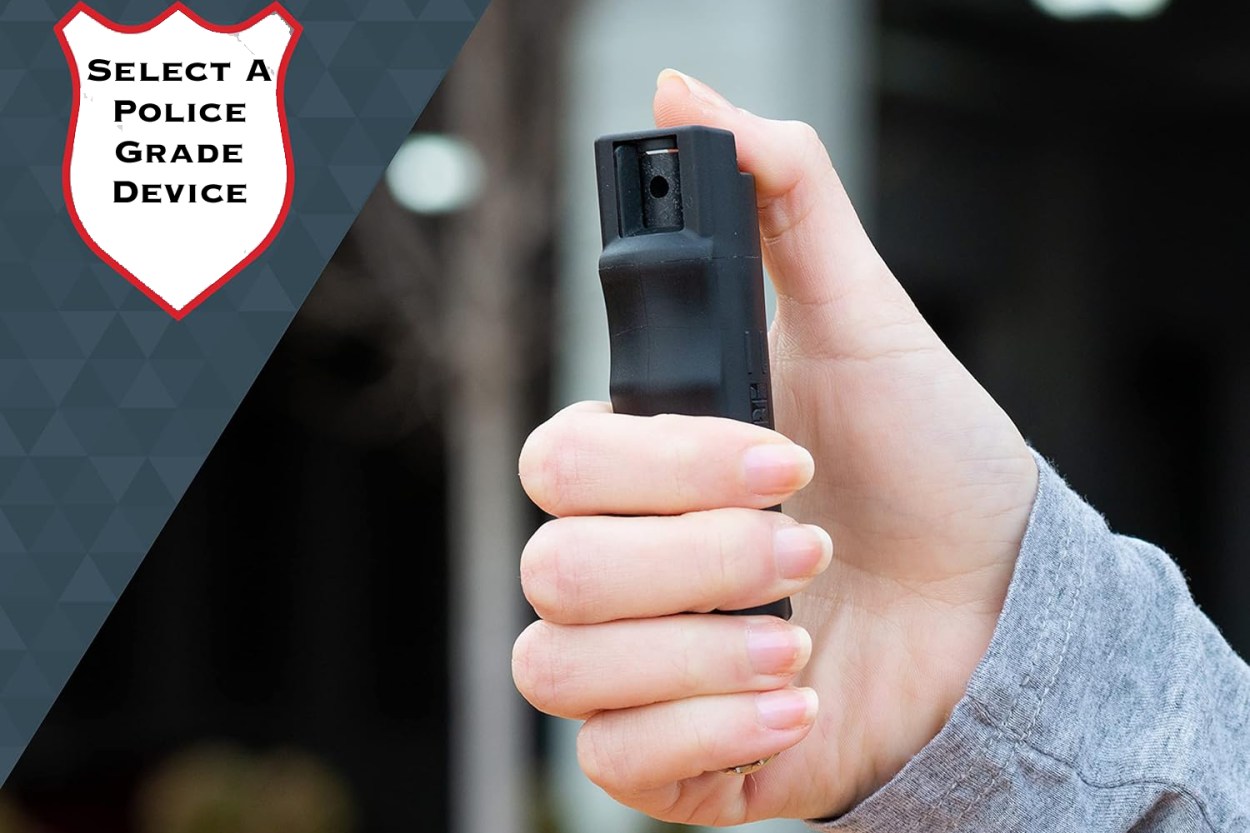
Pepper spray (OC) and CS or CN tear gas are non-lethal chemical irritants used for self-defense and crowd control. All three types are often called tear gas, but each uses a different chemical compound. This article explains your options to help you make informed decisions.
Links to product recommendations are at the end of this article.
Pepper spray (OC) is made from the extract of the commonly available hot pepper fruit. It produces debilitating pain and temporary blindness.
CS tear gas is the updated version of CN; the U.S. military invented both. Like pepper spray, CS and CN are also nonlethal weapons. All three types affect the eyes and respiratory system.
Today, quality products contain either pepper spray or CS tear gas, or both pepper spray and CS teargas. Some products also include UV dye markers in the formulation, a feature that can help police identify assailants many hours later.
Note: The formulation and strength of police-grade products differ from those found in most stores. For the best protection, select a product from a manufacturer who also makes products for law enforcement agencies.
When selecting a product, first consider the anticipated threat. Dispensers that stream a solid spray of the chemical agent will splash and get under eyeglasses. This solid stream is also easier to use against multiple assailants. Conversely, dispensers that shoot a stream of gel are better for use in a crowded environment. The other primary alternatives are the cone or fogger dispensers commonly used for riot control. These disperse a broad chemical cone or fog-mist to affect a group of people. The user of a fogger device must wear a gas mask.
HAVE REALISTIC EXPECTATIONS
It is essential to understand that pepper spray, as well as CS and CN teargas, are not 100% effective for stopping an attack.
While pepper spray and other teargas products can be helpful in self-defense situations, they do not always work. They are not always effective. They are not a guaranteed self-defense solution.
The primary advantage of pepper spray and CS teargas is that these tools provide a self-defense solution between the use of physical force and deadly force.
The maximum range of a consumer-grade tear gas product varies by brand and model, but is typically 8- 12 feet (2.4-3.5m). Respected manufacturers will clearly state the effective range on the device’s label.
Tests indicate that discharging a device 18 inches from an eye will not produce a long-lasting injury. However, most manufacturers recommend a minimum distance of 3 feet (1m).
Though not as effective as a firearm for neutralizing a deadly threat, these devices are nonetheless highly useful. They are especially valuable for personal protection in situations involving a less-than-deadly violent attack.
INSTRUCTIONS FOR USING YOUR DEVICE
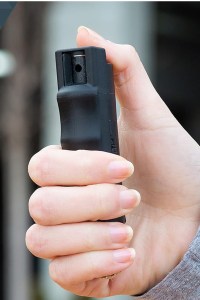
Use all four fingers of your hand to grasp a standard-size small dispenser. Then, use your thumb to discharge the chemical from the canister.
If you use your index finger rather than your thumb to activate the device, the natural effect will be to shoot the stream of liquid low rather than squarely into the assailant’s face.
Note: When using pepper spray rather than CS teargas, the incapacitation of your assailant requires that the liquid be applied in sufficient quantity to entirely flood both eyes of the assailant.
During use, deliver either 2-3 second bursts or a steady stream of spray to the assailant’s eyes. Don’t stop spraying until their eyes are entirely doused or the attacker runs away. Do not stop spraying to see if it is working. After removing thumb pressure from the device’s button, it will instantly stop the flow of the chemical.
Keep delivering bursts or a solid spray onto the assailant’s eyes until their aggression has entirely stopped and they are debilitated.
Once any of these chemicals hit an assailant’s face, it typically takes 2-5 seconds for them to react. Still, it’s not unusual for it to take several additional seconds to stop an act of aggression.
Unlike pepper spray (OC), CS and CN teargas should be considered allergens, with some people being more allergic than others. With CS and CN teargas products, the effect and severity will vary from person to person.
In addition, mentally ill people and those on drugs are generally less affected by CS or CN teargas than the same person doused with pepper spray.
An assailant wearing eyeglasses or sunglasses may take longer to react to these chemicals. Eyeglasses, goggles, and the brims of caps can reduce the quantity of the chemical reaching the assailant’s eyes. Therefore, keep spraying until the aggression has stopped.
For this reason, CS teargas remains popular since it can be more effective in incapacitating an assailant who is wearing glasses or goggles. Considering this, a combination of police-grade pepper spray and CS teargas is ideal.
Product Selection
Specific product recommendations are included at the end of this article.
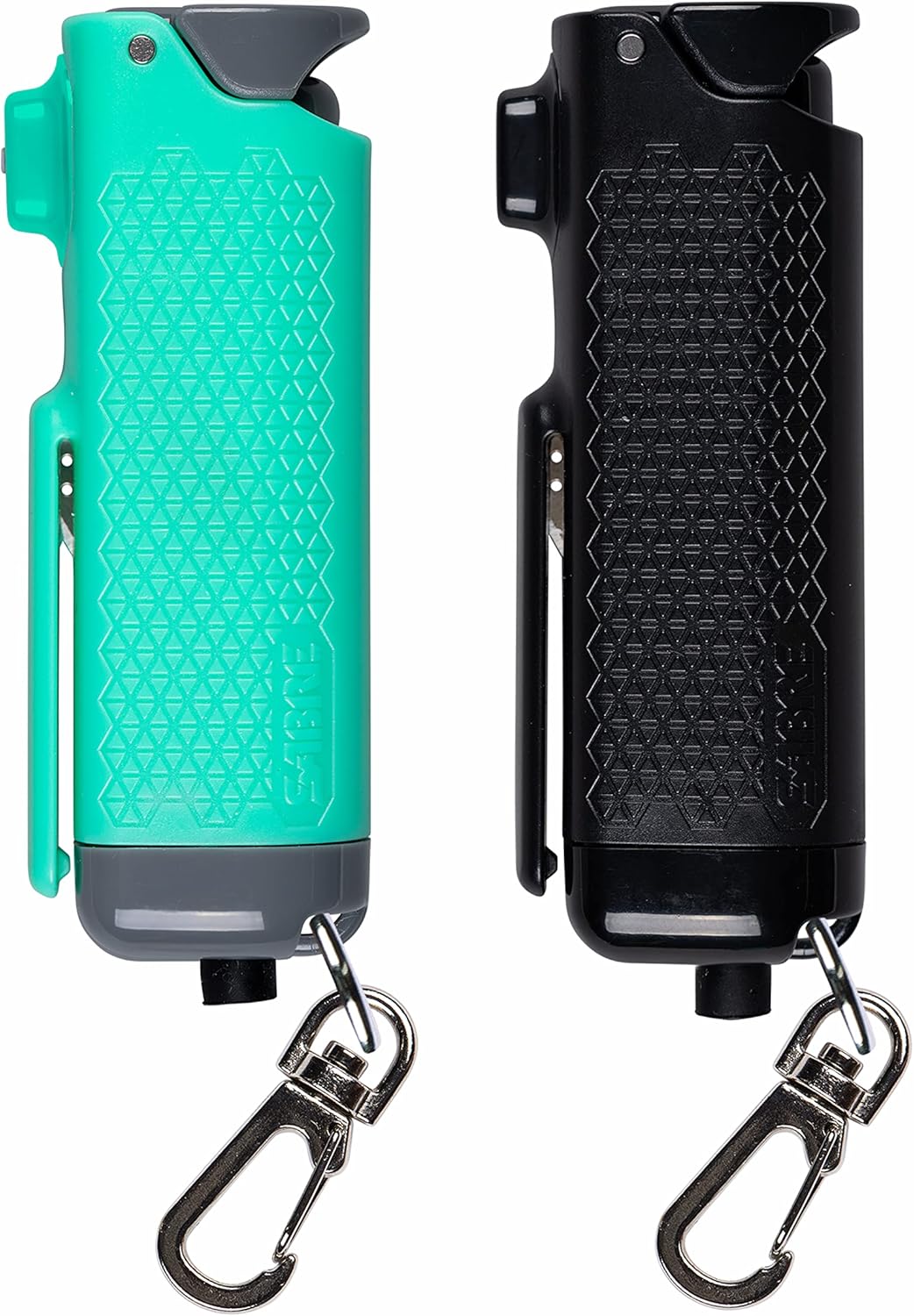
Pepper spray and tear gas chemical agents made for the general public are typically pre-loaded into aerosol containers of various sizes and then pressurized. These are simple to use, compact to carry, inexpensive to purchase, and available in various configurations to meet the users’ lifestyle and physical abilities.
Unfortunately, many of the commonly sold canister-type devices are impractical because the user must determine the direction of the spray-nozzle before use. In contrast, a quality product will be tactile, making it easy to grab the device and instantly point it in the correct direction.
A quality product will also have a viable safety mechanism. A sure but easy-to-release safety mechanism is necessary to reduce the likelihood of an accidental discharge.
Select a brand/model that contains either a police formulation of pepper spray CS teargas, or both.
Pick a model that is convenient to carry, that is of a size and style that is conducive to your lifestyle. A device that facilitates routine carry is far better than a “perfect” device that you have left at home.
Replace your device if it has dispensed more than the ½ second spurt recommended for initial testing. Or if it is three years old or damaged.
Some devices, such as the Kimber PepperBlaster and the Byrna SD Kinetic Launcher, look like handguns. This trait can make them easier to aim and more intimidating. But these devices are also significantly larger so some find them inconvenient for daily carry. Plus, in some situations, an assailant, or others, may perceive the device to be a firearm. This error might provoke a more deadly response.
From a user’s perspective, Gel-type pepper spray is the most controllable formulation because it is sticky and produces less splash. As a result, self-contamination and the inadvertent exposure of others to the chemical are less likely.
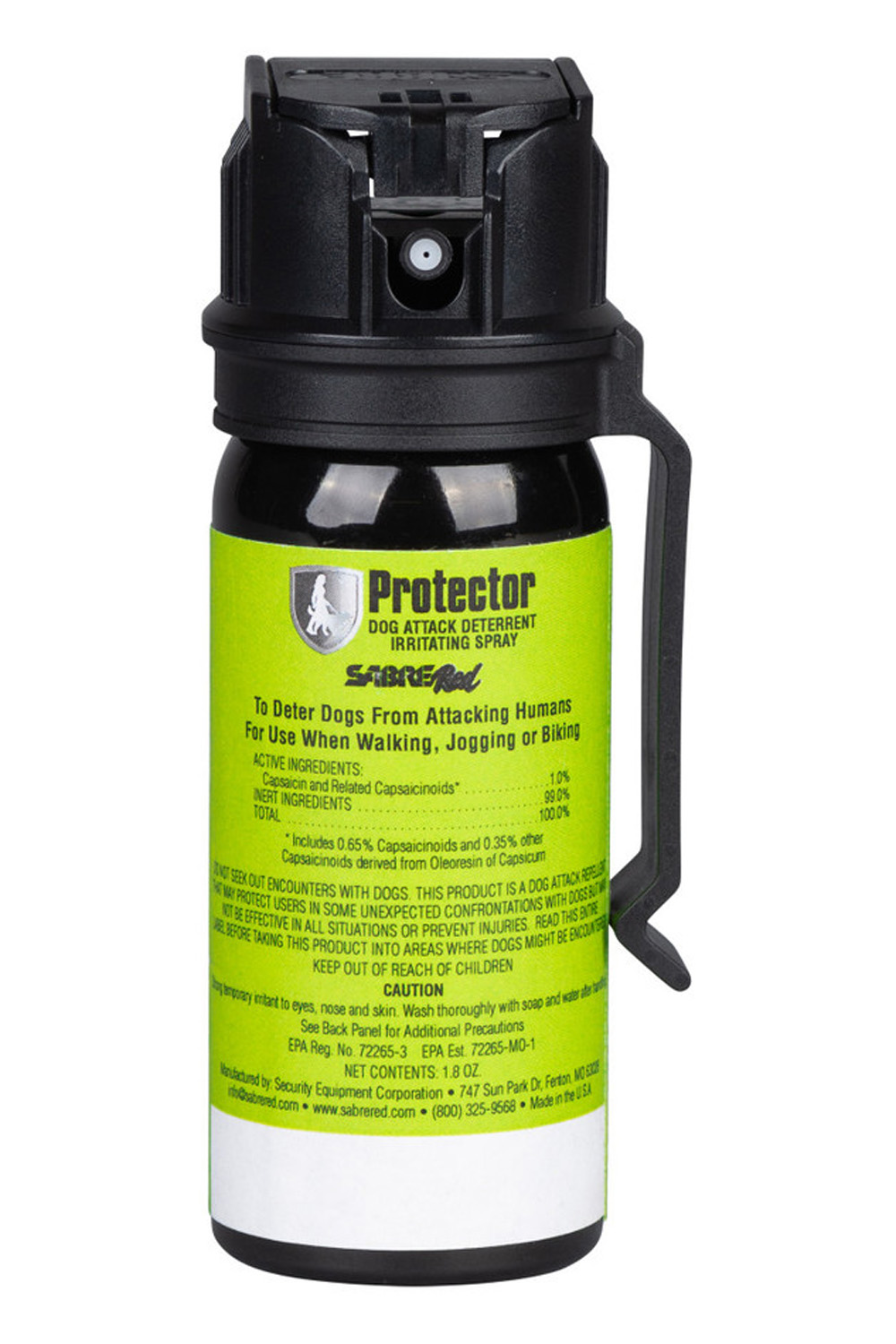
Protection: Vicious Dogs & Animals
Pepper spray intended for use against humans will sometimes work against aggressive dogs and other predators. However, it is less likely to work on an animal engaged in an attack.
Animal-specific pepper spray formulations are available for dogs and bears. However, their formulas are less effective against humans.
Pepper spray products sold as “bear spray” can contain as much as 50% Oleoresin Capsicum (OC). This quantity of the active ingredient is far more than the dosage used for humans. However, counterintuitively, this high concentration of OC makes the spray less effective against human attackers.
If your concern is animal attacks, purchase a device designed for the specific type of animal. We are unaware of any research on animals other than dogs and bears.
WHAT TO EXPECT AFTER DOUSING AN ATTACKER
Exposure to pepper spray (OC), CS, or CN teargas will produce an assortment of debilitating effects. These vary in intensity according to the degree of exposure and the product’s chemical composition.
Typical responses include forcing eyelids to close tightly, intense crying, difficulty breathing, the feeling of burning skin, and sometimes uncontrollable coughing or chest pain that might be perceived as a heart attack.
Even without treatment, these effects usually pass within 15-45 minutes. All three of these formulations are considered non-lethal weapons.
Initial exposure can also bring on a panic attack. In some situations, it may also bring an adrenaline-fueled “flight” response as the afflicted person may desperately want to flee from further exposure.
Users of these devices must understand that their target can continue their violent activities, use a weapon, physically fight, or run unless they have been exposed to a sufficient quantity of the chemical agent.
Pepper spray will not incapacitate an attacker unless their face and eyes have been hit directly by the liquid or gel chemical. Whereas CS teargas can cause labored breathing and a burning sensation to the skin, especially sweat-prone areas such as the neck, underarms, and groin, even without direct exposure to the eyes or face.
Remember: While all three chemical compounds (pepper spray, CS, and CN) cause extreme discomfort, they are harmless unless there is a serious underlying health problem such as COPD or asthma.
Note: Thoroughly read the manufacturer’s cautions and directions before using your pepper spray or teargas device. This article is not a substitute for the manufacturer’s instructions and warnings. They must be given precedence over this information.
SIDE EFFECTS OF USE
If you use your device, you will likely get some of the chemical on yourself, regardless of whether your device dispenses via a liquid stream, cone of spray, fog, or gel. So, irrespective of the delivery mechanism, expect some personal exposure to the chemical. And with this, there are some undesirable effects for you as the user and innocents who may be in your proximity.
This exposure is additionally likely if the wind is blowing toward you. Pepper spray “gel” is the least likely to be affected by wind.
Exposure to even a slight mist of any of these products will bring temporary yet unpleasant side effects. While a minor exposure may not debilitate you, these effects must be understood and anticipated.
After Use
After using any of these chemical self-defense tools, don’t touch your face with your hands or rub your eyes even with a finger, as this can introduce residue into your eyes or the pores of your skin. Understand that the hand that held the device will likely be contaminated.
Immediately after using any of these chemical agents, wash your hands thoroughly with soap and water. Hose off your shoes and change your clothing as soon as practicable. Since your clothing is likely contaminated, place these items in a plastic bag until they can be washed.
TREATMENT FOR EXPOSURE TO PEPPER SPRAY OR TEAR GAS
If specialized decontamination products or other instructions from the manufacturer are absent, the following decontamination method is universal for pepper spray and for CS or CN teargas.
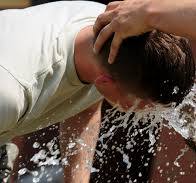
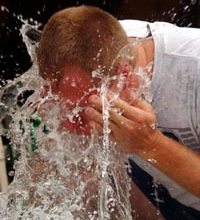
If exposed to pepper spray or tear gas, the best treatment is to force yourself to breathe normally, and flush your skin with cool, fresh water from a constantly flowing source such as a garden hose.
Use hand soap and flowing fresh water to decontaminate skin, or use a spray bottle filled with a solution made from 10% Dawn Dishwashing Liquid and water. Do not use these soaps on the face, at least not initially.
To decontaminate eyes, use either saline solution or copious amounts of fresh water. Blink constantly to increase the natural squeegee-like effect of your eyelids as this pushes the chemicals out of your eyes more quickly yet gently.
If you have access to no-tears baby shampoo, combine it with fresh water and use it to speed the recovery process by using it to decontaminate your face and gently flush your eyes. A misting spray-bottle can also be used to apply this solution gently.
Do not use other types of soap around your eyes. Most soaps will cause additional burning and irritation, whereas no-tears baby shampoo will not further irritate the eyes.
If clean, flowing water from a hose or sink is unavailable, add baby shampoo to a disposable water bottle, shake slightly to mix the soap into the water, and then replace the bottle cap. Use a knife to prick a small hole in the bottom edge of the bottle, then squeeze it to create a thin stream that can be directed into the eyes of the contaminated person. Repeat as needed.
With this, encourage the contaminated person to breathe normally and encourage them to relax. If clothing cannot be removed, soak the person’s torso clothing in water to reduce ongoing off-gassing.
An environment with a gentle breeze of fresh air, combined with the above method, will speed recovery and help discomfort pass more quickly.
Even without decontamination, the irritation will usually pass in 15-60 minutes. Discomfort is temporary.
IMPLEMENTATION & PLANNING
We recommend keeping additional devices in the door pocket of your vehicles and on your keyrings.
While it may be advisable to consistently use the same device among family members to avoid operating confusion during an emergency, exceptions may be advisable. For example, keeping a larger device in your vehicle that is readily accessible by the driver may be advisable. Situations involving cars overwhelmed by crowds of protesters are becoming more common.
Storage: The manufacturer’s instructions typically indicate that these devices should not be exposed to temperatures above 120 degrees Fahrenheit (49 C), making storage in a vehicle problematic. Nonetheless, many owners report that their devices still work fine after exposure to summer heat in a vehicle.
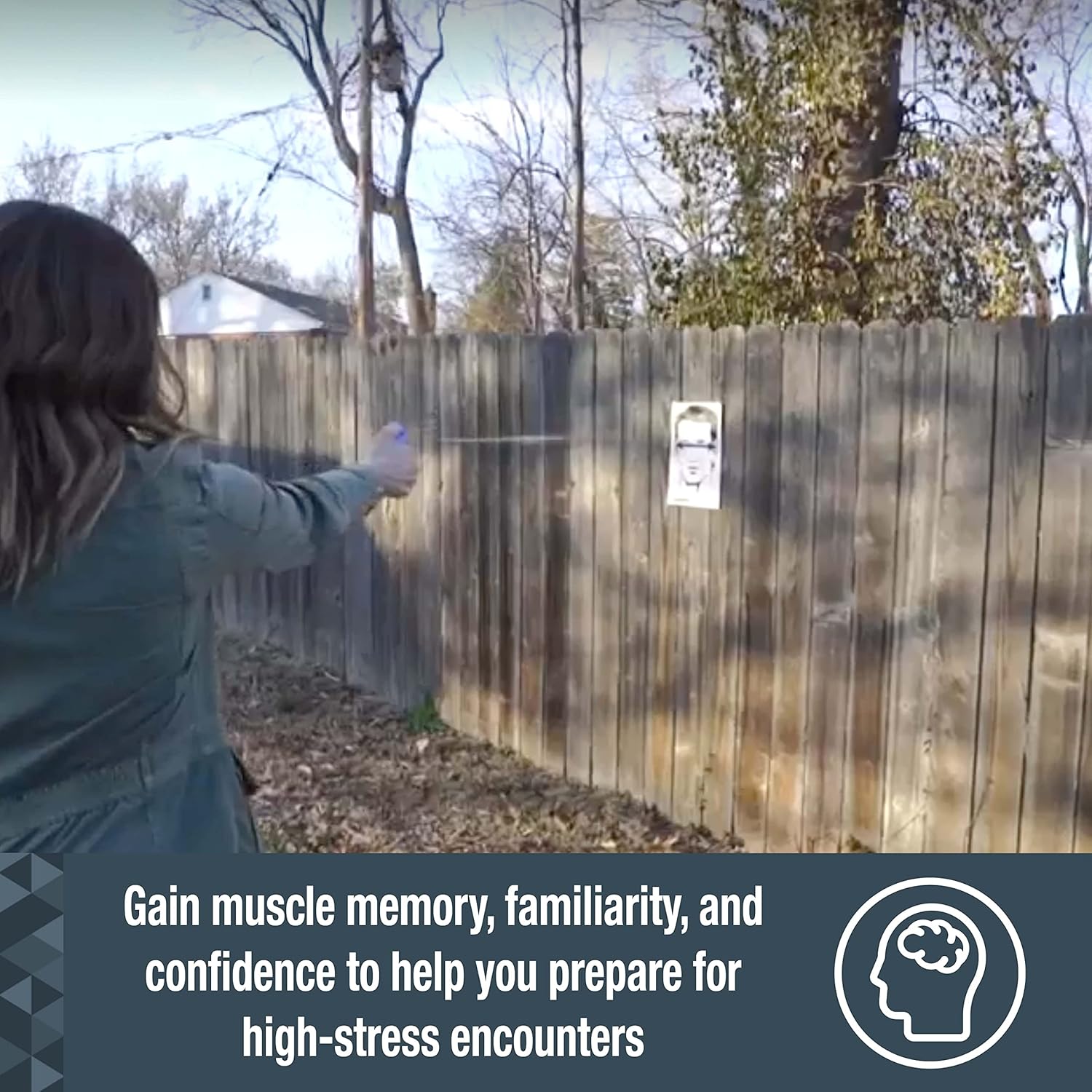
Testing: Before starting to carry a pepper spray device, test it. To accomplish this, in a safe place outdoors, release one quick 1/2-second burst toward a head-high target that is 10 feet distant. (So you know it works.) Practice devices containing water are readily available and should be used for training.
Legal Considerations
As odd as it may seem, pepper spray and tear gas are not legal everywhere. Therefore, it is essential to understand your local laws before possessing or using these devices.
If you intend to travel with your device, know the laws in your transit States and the laws for your destination. Most airlines allow small devices to be packed in checked luggage but not carry-on bags.
In most jurisdictions where pepper spray is legal, you still must be 18 years of age or older to possess these self-defense tools.
Children and Unauthorized Users
Since pepper spray, CS, and CN teargas are all considered weapons, it is essential to keep these devices out of the hands of children and other unauthorized individuals.
Still, if a child does play with it, they will likely only make that mistake once since exposure is highly unpleasant. Still, it is the owner’s responsibility to keep weapons out of the hands of unauthorized users.
In some jurisdictions, pepper spray, as well as CS and CN teargas, are considered dangerous weapons.
AFTER YOUVE USED YOUR PEPPER SPRAY OR TEAR Your Pepper-Spray or Teargas Device
Even if your assailant runs away and no harm comes to you or anyone else, immediately call the police and report the incident.
Immediately report pepper spray or teargas use against a human. In some locales, you must also report use against an animal.
When you tell the police dispatcher about the situation, be sure to include that you were in fear for your life or your physical safety. Self-defense use, to protect you or another person from a violent attack, is the only justified use of these chemical agents.
This police report is additionally vital as criminals have been known to report the incident themselves—claiming they were the victim of an unprovoked assault. With this, some have also filed a civil lawsuit seeking damages, claiming they were assaulted. Therefore, to minimize the possibility of unnecessary confusion and legal problems, be the first to call the police.
Wasp Spray as an Alternative to Pepper Spray and Tear Gas
Don’t do it! Some people advocate using ‘wasp spray’ as a weapon against a human attacker, claiming it is more effective than pepper spray. This is ill-advised as it can cause blindness or serious injuries.
Its use against a human, or even an animal, may also result in criminal prosecution and/or substantial civil liability. Several courts have issued judgments asserting that wasp spray is a chemical weapon equivalent to a chemical warfare weapon.
SUMMARY
If it is legal in your area, the every-day-carry of a small, concealed pepper spray device is a wise decision.
Pepper spray works effectively against criminal assailants as well as those who are mentally ill or on drugs; plus, it is available in many different sizes and device styles – including stylish devices. So, for most people, this makes ‘pepper spray’ the favored choice over CS or CN teargas.
However, if you are looking for the most effective device, find one that combines both police-grade pepper spray and CS teargas. Or a 3-in-1 formula that also includes UV dye markers to help authorities identify the perpetrator.
Or, if you’ll need your device in a densely populated area, like in a church or meeting room, pepper spray ‘gel’ is likely your best choice. Dispensed as a gel rather than a liquid, pepper spray gel doesn’t have the splash effect inherent to other sprays. As a result, the gel is less likely to affect innocent people who are nearby.
Still, the most crucial consideration is to select a product made by a company that also makes devices used by law enforcement agencies; a product that uses the same formula used in their law enforcement products.
Be proactive. Be prepared and ready to roll into any situation.
PRODUCT RECOMMENDATIONS
#1 Recommended Basic Pepper Spray Device + Practice Device
#1 Recommended Ultra-Small Keychain Device
#1 Recommended “Stylish” Device
#1 Recommended Device for Runners
#1 Recommended 3 in 1 Device (Pepper Spray + CS Tear Gas + UV Marking Dye)
#1 Recommended Device for Law Enforcement Officers
#1 Recommended Device for Pocket of Car Door
#1 Recommended to Disperse a Crowd of Attackers
#1 Recommended Product for Vicious Dogs
Click Here to download a PDF copy of this article
 READINESS UNIVERSITY

You must be logged in to post a comment.